
Dust Control for Ship Loading and Unloading
- Oct 31, 2025
- 2 min read
Updated: Nov 27, 2025
Mobile dust collectors provide an effective solution to comply with health, safety and environmental regulations AND can increase operational efficiencies; enabling faster ship loading / unloading times and minimizing the loss of valuable products.
Huge volumes of airborne dust can be generated when bulk cargo materials are loaded / unloaded at ports and rail / road truck loading facilities. This poses not only a health, safety and environmental risk but also creates operational challenges.

Health, Safety and Environment. Driving Demand for Effective Dust Control Solutions at Ports.
Ports are an integral part of global infrastructure, businesses and residential communities have been built around them. An increase in maritime traffic means that ships arriving to load and unload bulk goods are subject to tighter timeframes and increased costs. There is also a wider recognition of the importance of managing dust created during loading, unloading and tighter regulations to adhere with to protect the health and safety of workers.
Dust is created when dry product, for example, grains, fertilizers, coal, iron ore, bauxite or sands is loaded into or from vessels or hoppers via conveyors or buckets/clamshells.
Protecting the health and safety of our maritime workers and local residents from the hazardous effects of respirable dust is by far the main priority. Followed by protecting our valuable waterways and oceans from dust and contaminants that can pollute and harm our sea life and vegetation. However in addition, the longer vessels are in ports loading / unloading the more fees are incurred (demurrage and labor), implementing effective dust control measures can generate significant operational efficiencies and cost savings. Increasing the efficiency of ship loading / unloading means that vessels have quicker turnaround times and spend less time in ports / saving on labor and demurrage costs.
Dust Control During Loading / Unloading. Benefits Summary.
Protecting the health and safety of workers from hazardous respirable dust particles.
Protecting visitors, residents and businesses that surround ports from exposure to harmful dusts.
Protecting our valuable waterways and oceans from airborne dust and contaminants that may pollute and harm our sea life and vegetation.
Improved efficiencies – dust control has proven to allow for faster conveyor speeds, reduced loading and unloading speeds, saving time and money.
Faster turnaround times the increased speed and efficiency of loading / unloading means vessels are spending less time in ports reducing demurrage costs.
Reclaiming valuable product that otherwise would have been lost to the atmosphere.
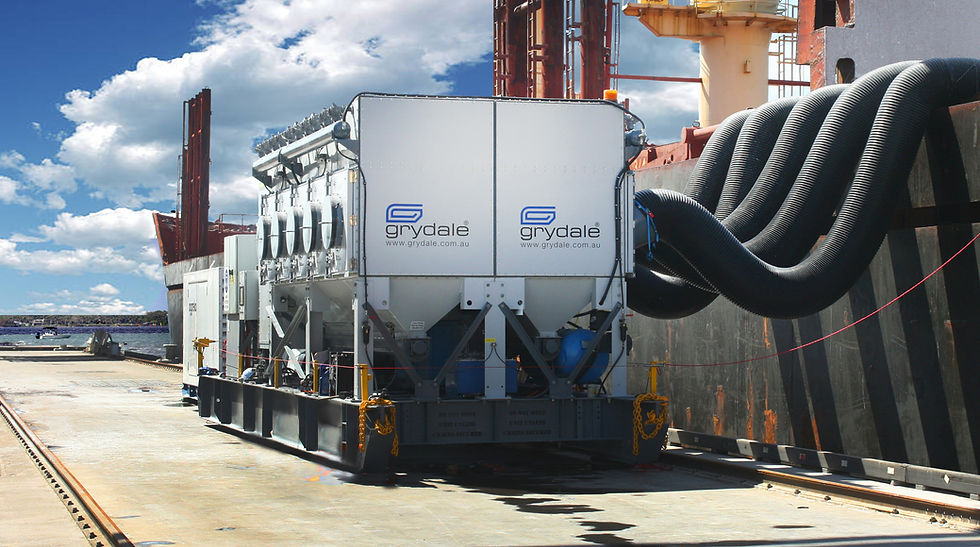
Mobile Dust Collectors. Dust Extraction at the Source.
Grydale mobile dust collectors can be easily positioned on port loading / unloading decks. Skid mounted units can be moved using cranes or castor wheels. Alternatively track units are self-propelled to move into position when required and moved out of position when not in use. Units can be used to manage ship loading and unloading of a wide range of products either via clamshells or conveyors. Single air intakes can be used to extract dust from a single source or multiple side air intakes can be used to extract dust from multiple sources (e.g. lowered into a ship hull during loading).
Grydale JMS M-Series dust collectors offer:
Air Volumes: 6m3/s (12,000 CFM) to 60m3/s (125,000 CFM)
Mobility options: skid, caster wheel, track-mounted
Power options: Diesel, Electric, Hybrid


Comments